
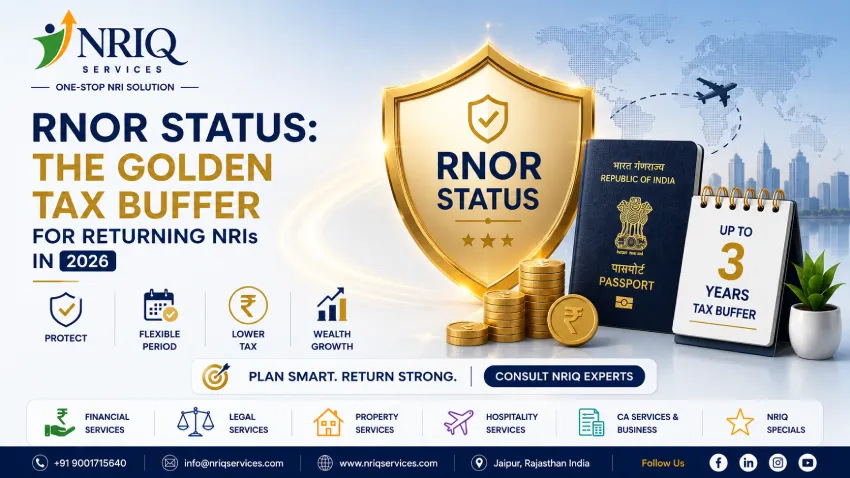
Moving back to India is an emotional and financial milestone. It requires a high “Intelligence Quotient” to manage the transition. The Indian tax system offers a unique “Golden Buffer” for you.
This buffer is known as the RNOR (Resident but Not Ordinarily Resident). In 2026, staying compliant while transitioning is vital for wealth. At NRIQ Services, we ensure your homecoming is tax-efficient.
Our founders bring 40+ years of institutional banking and tax expertise. Abhishek Singh Parihar leads with a “Risk-First” credit lens. Madhupam Krishna ensures your wealth strategy is ethically optimized.
What is RNOR Status? The Hybrid Identity
RNOR is a bridge between being an NRI and a full resident. Technically, you are a “Resident” for the Indian tax department. However, you enjoy the tax benefits of a Non-Resident.
This status allows you to settle back in India comfortably. It protects your global earnings from being taxed in India. It is a temporary gift from the Indian Income Tax Act.
We replace “informal” family guesses with data-driven, quality solutions. Our process-oriented approach ensures your status is correctly identified. We treat your transition with the rigor of elite banking.
Qualifying for RNOR in 2026: The Statutory Math
You don’t simply “choose” to be an RNOR; you qualify for it. The law uses two specific tests to determine this status. These tests look at your travel history over ten years.
The 9-out-of-10 Year Rule
You qualify as an RNOR if you were an NRI previously. Specifically, you must be an NRI in 9 out of 10 years. This looks at the years preceding the current financial year.
The 729-Day Stay Rule
You must also pass the physical presence test in India. Your total stay must be 729 days or less in seven years. If you meet either, you can claim the RNOR status.
Abhishek uses his 20+ years of banking experience to audit dates. We help you integrate these residency tests into your plan. This ensures you stay ahead of the technology curve in India.
The Tax Shield: Why RNOR is a Wealth Savior
The biggest benefit of RNOR is the exemption on foreign income. Usually, a full resident must pay tax on global earnings. As an RNOR, your “Foreign Income” remains 100% tax-free.
Tax-Exempt Global Income Sources
The 120-Day Trap and “High-Income” NRIs
Budget 2026 has kept the strict rules for high-income NRIs. If your Indian-sourced income exceeds ₹15 Lakh, beware of stay limits. Staying more than 120 days can trigger a status change.
In this scenario, you automatically become an RNOR for that year. This happens even if you haven’t “moved back” to India permanently. The 120-day limit is a trap for those on long holidays.
Our system-driven platform automates your stay and income tracking. This ensures you never cross the threshold by accident. We provide value for money by preventing high-tax liabilities.
Deemed Residents: The Stateless NRI Status
If you are an Indian citizen not taxed elsewhere, listen closely. The “Deemed Residency” rule can label you as an RNOR. This applies if your Indian income is over ₹15 Lakh.
You become an RNOR even with zero days spent in India. This rule targets NRIs living in tax-free zones like Dubai. It ensures that “stateless” income is captured by Indian laws.
We provide a one-stop solution for these complex “Deemed” queries. Our ethical framework ensures you stay compliant with Section 6(1A). We replace “informal” advice with institutional-grade banking expertise.
FEMA vs. Income Tax: The Residency Conflict
FEMA and Income Tax laws view “Residents” very differently. For the Tax Dept, you are an RNOR (a type of resident). For FEMA, you become a “Resident” the day you return.
The Impact on Bank Accounts
The moment you return to India, FEMA mandates an update. You must convert NRE accounts into “Resident” or RFC accounts. NRO accounts must be converted to regular savings accounts.
RFC Accounts: The RNOR’s Best Friend
Resident Foreign Currency (RFC) accounts allow you to hold USD. You can park your repatriated foreign funds in these accounts. Funds in RFC accounts are fully repatriable back to abroad.
Comparative Data: NRI vs. RNOR vs. ROR
Understanding the progression of your status is vital for planning. We provide a clear data comparison for your 2026 roadmap. Every homecoming journey is different and requires precise math.
Residency Comparison Table (2026 Rules)
| Feature | NRI (Non-Resident) | RNOR (Buffer Status) | ROR (Full Resident) |
| Indian Income | Taxable | Taxable | Taxable |
| Foreign Income | Tax-Free | Tax-Free | Taxable |
| Global Assets | No Disclosure | No Disclosure | Mandatory Disclosure |
| Repatriation | Limited | Flexible (RFC) | Restricted |
| Duration | Unlimited | 2 to 3 Years | Permanent |
Planning Your Return: Asset Restructuring
Don’t wait until you land in Jaipur to start tax planning. The best time to restructure assets is before becoming an RNOR. Liquidating certain global assets as an NRI might be better.
We help you analyze the tax impact in both countries. We use our “Risk-First” lens to spot future compliance gaps. Abhishek treats your relocation with the rigor used in banking.
Our process-oriented approach handles the technical heavy lifting. We coordinate with legal and CA teams for a smooth transition. We provide the “Heart and Hustle” needed for your peace of mind.
The NRIQ Advantage: Quality Solutions for Returnees
Moving back to India should be a joyous occasion, not a tax mess. We believe that professional guidance is an investment in peace. Our mission is to ensure your Indian roots grow securely.
Is your Indian retirement plan ready for 2026?
Checklist: Preparing for Your RNOR Status
| Task | Timing | Action Required |
| Stay Count | Pre-Arrival | Audit stay days in the last 7 years. |
| Bank Update | On Arrival | Open an RFC account for foreign funds. |
| Asset Audit | Pre-Arrival | Sell global assets if tax-free abroad. |
| Document Vault | Continuous | Keep TRC and foreign tax filings ready. |
| ITR Filing | Annual | Declare status clearly as RNOR in ITR. |