
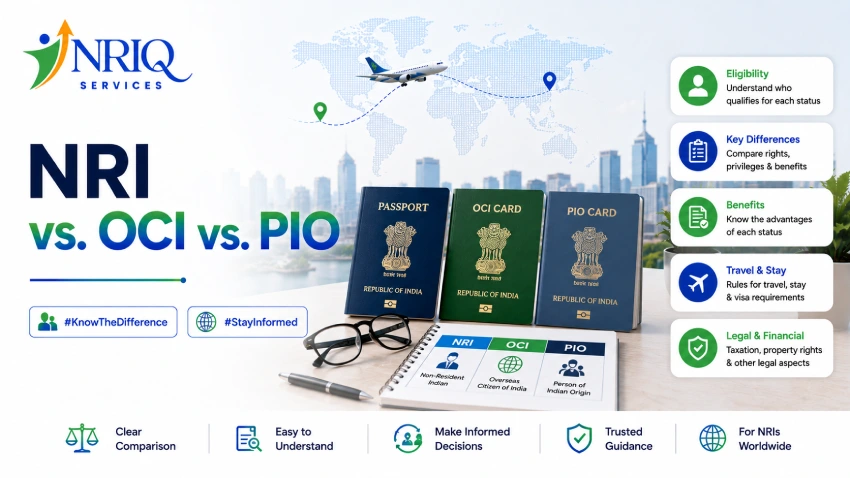
For the millions of Indians living across the globe, the connection to the motherland remains deep, whether through family ties, real estate investments, or business ventures. However, navigating the legal terminology that defines your relationship with India—NRI, OCI, and PIO—can often feel like solving a complex puzzle.
As of 2026, the regulatory landscape has shifted. The merger of schemes and updated Budget 2026 compliance norms mean that what was true five years ago might no longer apply to you today. At NRIQ Services, we specialize in providing Quality & Up-to-Date Solutions for these exact “Questions & Queries”. Based in Jaipur, our founders—Madhupam Krishna (CFP/SEBI RIA) and Abhishek Singh Parihar (AVP with 20+ years in banking)—bring a system-driven and process-oriented approach to help you manage your roots with total clarity.
The Three Identities: Who is Who?
Understanding your status is the first step toward legal and financial security in India. Here is a breakdown of the three categories:
NRI (Non-Resident Indian)
An NRI is an Indian Citizen who resides outside India.
OCI (Overseas Citizen of India)
An OCI is a Foreign Citizen of Indian origin who holds a lifelong “OCI Card”.
PIO (Person of Indian Origin) – The Discontinued Status
The PIO scheme was officially discontinued and merged with the OCI scheme in January 2015.
Key Differences: Rights, Restrictions, and Privileges
Choosing the right path for your Indian engagement depends on understanding these critical differences in 2026:
A. Citizenship and Passports
B. Visa and Travel
C. Political Rights
D. Government Employment
The “NRI Quotient” Comparison Table (2026 Edition)
| Feature | NRI (Non-Resident Indian) | OCI (Overseas Citizen of India) |
|---|---|---|
| Passport Held | Indian Passport | Foreign Passport |
| Visa Requirement | None | Lifelong Multi-entry Visa |
| Voting Rights | Yes | No |
| Residency in India | Unlimited | Unlimited (Indefinite stay) |
| FRRO Registration | Not required | Exempted for any duration |
| Government Jobs | Eligible | Not Eligible |
| Property Rights | Can buy residential/commercial | Parity with NRIs (Residential/Commercial) |
| Agricultural Land | Restricted | Prohibited (except inheritance) |
Financial and Property Matters: A Level Playing Field?
In the economic, financial, and educational fields, the Government of India has granted parity to OCIs with NRIs. However, there are a few “fine print” areas where your status matters immensely.
Banking Privileges
Both NRIs and OCIs are permitted to open and operate:
Real Estate: The Agricultural Barrier
While both categories can freely purchase and own residential and commercial properties, neither NRIs nor OCIs can purchase agricultural land, plantation properties, or farmhouses.
Professional Practice
OCIs enjoy parity with NRIs in pursuing professional careers in India, including:
Why the PIO to OCI Conversion is Critical in 2026
If you are still holding a physical PIO card, you are in a “vulnerability gap.” While the government “deems” you an OCI, immigration authorities at airports are increasingly strict about physical documentation.
How NRIQ Services Bridges the Identity Gap
Navigating whether you should stay an NRI or transition to OCI status (if eligible) requires an ethical and experience-driven partner. At NRIQ, we provide a one-stop solution for these identity-based queries:
Our Promise: Value for Money
We believe that professional advice should be an investment, not an expense. By ensuring your status is correctly identified and registered, we help you avoid:
Conclusion: Your Indian Identity is Your Legacy
Whether you are an NRI holding onto your Indian passport or an OCI cherishing your Indian heritage through a lifelong visa, your status is the gateway to your interests in India. As regulations like FEMA 2026 make cross-border transactions faster and more transparent, being correctly categorized is more important than ever.
Don’t let distance or legal complexity separate you from your roots. Choose a partner that understands the “NRI Intelligence Quotient.”
Are you still holding a PIO card? Or are you unsure if your property is correctly registered under your current status?