
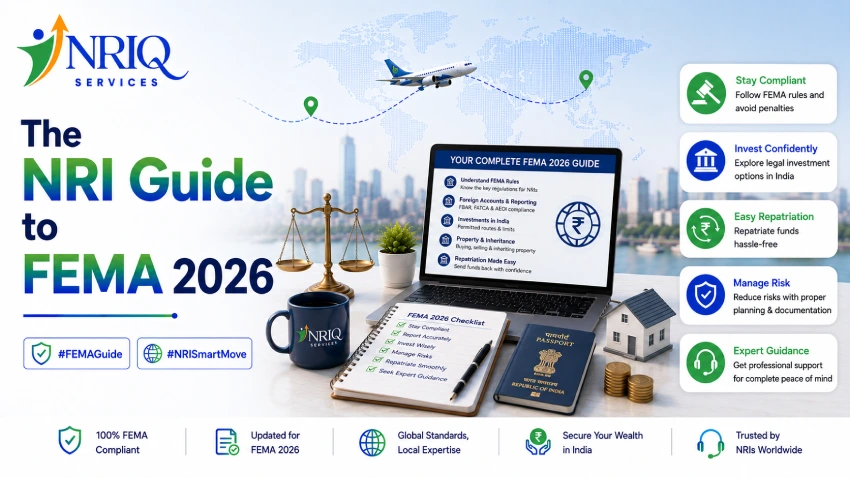
For any Non-Resident Indian (NRI) or Overseas Citizen of India (OCI), the term FEMA (Foreign Exchange Management Act) is not just a piece of legislation—it is the very oxygen of your financial existence in India. Whether you are sending money home to Jaipur for your parents, buying a luxury apartment in Gurgaon, or managing a portfolio of Indian blue-chip stocks, every single rupee that crosses the border is governed by FEMA.
In 2026, the landscape of foreign exchange has shifted. With the Reserve Bank of India (RBI) pushing for the internationalization of the Rupee and the introduction of the FEMA (Guarantees) Regulations, 2026, the rules of the game have become more streamlined yet strictly monitored. At NRIQ Services, we believe that “Quality & Up-to-Date Solutions” are the only way to protect your global legacy.
In this definitive 1800-word guide, we break down the complexities of FEMA, moving away from the “criminal” mindset of the old FERA era to the “management” mindset of modern India.
From FERA to FEMA: Why the “M” Matters
To understand FEMA, one must understand its predecessor: FERA (Foreign Exchange Regulation Act, 1973). FERA was born in an era of scarcity. India’s foreign exchange reserves were low, and the law treated every dollar leaving the country with suspicion. Violations were criminal offenses, often leading to imprisonment.
In 1999, as India’s economy matured, FEMA replaced FERA. The shift from “Regulation” to “Management” was a clear signal to the global Indian community: India is open for business. Under FEMA, violations are primarily civil offenses attracting monetary penalties. However, don’t let the “civil” label fool you. In 2026, with the integration of AI-driven tracking by the Enforcement Directorate (ED), non-compliance can still lead to the freezing of assets and penalties of up to 300% of the sum involved.
The FEMA Definition of an NRI (The “Intent” Test)
As we discussed in our previous blog, FEMA defines an NRI differently than the Income Tax Act. While the Tax Department counts your days (the 182-day rule), FEMA looks at your intent.
If you leave India for employment, business, or any other purpose indicating an indefinite stay abroad, you are an NRI under FEMA from Day 1. This is critical because your banking rights change the second you clear immigration. Holding a resident savings account while being a FEMA-NRI is a direct violation that our Co-Founder, Abhishek Singh Parihar, often saw during his 20+ years in banking at HDFC.
The Three Pillars of NRI Banking: NRE, NRO, and FCNR
FEMA strictly prohibits NRIs from holding regular resident savings accounts. You must convert these or open new accounts under the following categories:
A. NRE (Non-Resident External) Account
B. NRO (Non-Resident Ordinary) Account
C. FCNR (Foreign Currency Non-Resident) Account
FEMA Rules for Indian Real Estate (2026 Updates)
Real estate remains the favorite asset class for NRIs. However, FEMA has very specific “Yes” and “No” zones.
The “Green” Zone (Allowed)
NRIs and OCIs can purchase any number of Residential and Commercial properties. You do not need RBI permission for this. You can also inherit these properties from residents or other NRIs.
The “Red” Zone (Prohibited)
NRIs/OCIs are strictly prohibited from purchasing:
The Inheritance Exception: You can inherit agricultural land, but you cannot buy it. Furthermore, you can only sell inherited agricultural land to a resident Indian citizen.
Funding the Purchase
FEMA 2026 guidelines are very strict about the “Source of Funds.”
Repatriation of Funds: Getting Your Money Back
“Can I take my money out of India?” This is the #1 question at NRIQ.
The $1 Million Rule
From your NRO account, you can repatriate up to USD 1 Million per financial year. This includes sale proceeds of property, life insurance maturity, or your share of an inheritance.
FEMA 2026: The New “Guarantee” Regulations
In January 2026, the RBI issued the Foreign Exchange Management (Guarantees) Regulations, 2026. This is a game-changer for NRIs involved in business. It simplifies how guarantees are issued for cross-border trade and introduces Form-GRN for quarterly reporting.
For an NRI setting up a business in India, this means less paperwork and more transparency. However, it also introduces a Late Submission Fee (LSF) formula for delayed reporting: ₹7500 + 0.025% × [Amount] × [Years of Delay] At NRIQ, we use our system-driven tech to ensure you never hit these “Late Fees.”
Common FEMA Pitfalls: The Cost of “Informal” Help
Many NRIs rely on “informal” help from relatives or local brokers who may be well-meaning but are not regulatory experts. This leads to:
The NRIQ Advantage: Your FEMA “Intelligence Quotient”
At NRIQ Services, we don’t just provide definitions; we provide a One-Stop Solution.
Conclusion: Compliance is Your Best Investment
In 2026, India is no longer an “informal” economy. With the integration of the Income Tax portal and the RBI’s FEMA monitoring systems, transparency is the only way forward.
FEMA is designed to facilitate your growth, not hinder it—provided you follow the process. Don’t let your Indian legacy be compromised by a lack of “NRI Intelligence.”
Is your Indian retirement plan ready for 2026?
FEMA 2026 Compliance Checklist for NRIs
| Task | Frequency | Action Required |
|---|---|---|
| Account Conversion | Once | Convert Resident Savings to NRO/NRE |
| Repatriation Limit | Annual | Track against the $1M NRO limit |
| Property Purchase | Per Deal | Ensure “Source of Funds” is compliant |
| Form 15CA/CB | Per Transfer | Required for any outward remittance from NRO |
| KYC Update | Every 2 Years | Update your overseas address with your Indian bank |